
Çin mineral savaşını kazandı. Yayımlanan iki yeni kitapta, Batı'nın buna nasıl izin verdiği yer alıyor.
Nicholas Niarchos ve Tomasz Nadrowski, Çin'in kritik mineraller konusunda Batı'yı nasıl alt ettiğini anlamak için iki önemli kitabı kaleme aldı.
China won the mineral war. Two new books show how the West let it happen
Nicholas Niarchos and Tomasz Nadrowski have written two essential guides to understanding how China outmaneuvered the West in critical minerals
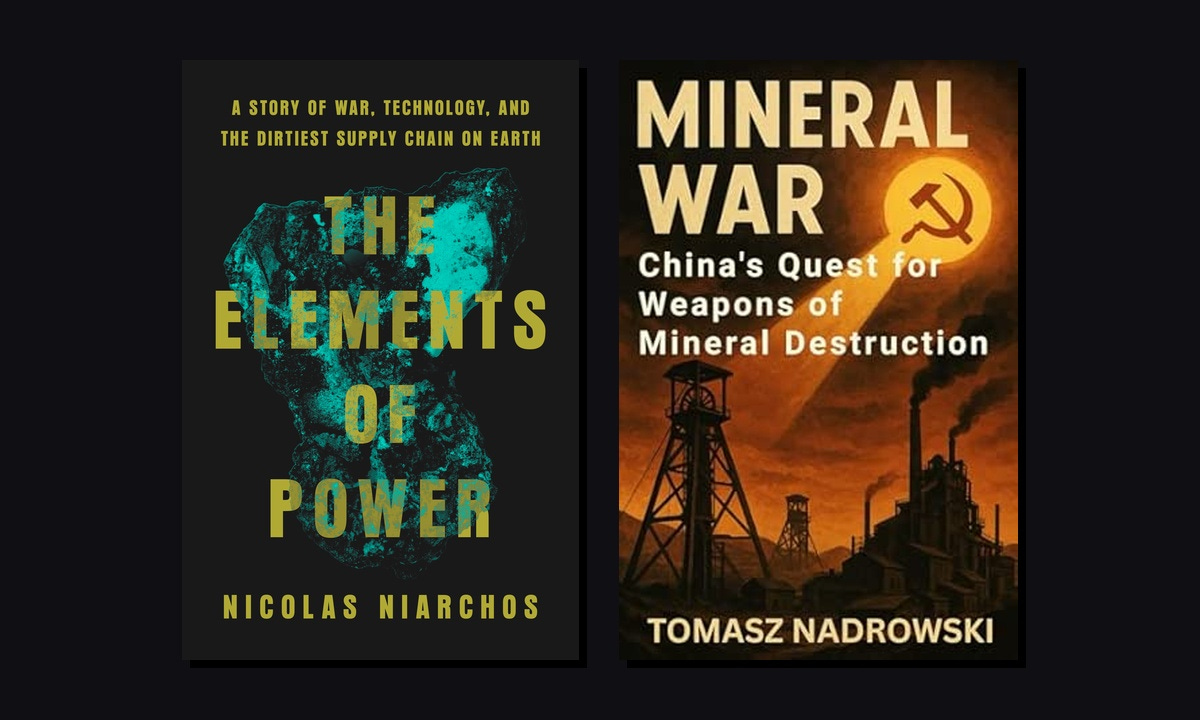
In early 2016 the Chinese mining company CMOC acquired one of the best copper and cobalt projects in the Democratic Republic of Congo from US miner Freeport-McMoRan. At the time mining was probably one of the least sexy industries, and had gone through a bruising period of low prices. The West had other things on its mind, and was about to be convulsed by Trumpism and Brexit.
Today, Chinese projects account for more than 80% of the DRC’s copper production, which in itself has risen dramatically over the past decade. We will need a lot more copper for data centers, grid transmission, and electric vehicles, and DRC is now the world’s second-biggest producer.
I remember a well-known PR firm trying to strongly persuade me at the time that CMOC was a private company and nothing to do with the state, even though a local SOE owned a stake.
That call - and many others like it - revealed a harsh truth. The West wasn’t just asleep while China became dominant in many critical minerals: it actively helped China into this position. Lawyers worked on the deals, banks in Hong Kong did the IPOs, and fund managers bought into the shares.
BHR Partners, a private equity fund co-founded by Hunter Biden1, former President Biden’s son, helped CMOC with the final piece of the acquisition. “The original idea of BHR was to be a cross-border outfit. It was a different time. Oligarchs used to be cool. We had a warm relationship with China,” Devon Archer, another founder of BHR, told journalist Nicholas Niarchos in his detailed book on the DRC, The Elements of Power.
Why did this all happen? In part because all these people believed and belonged in the international capitalist, free-trade system. It was very hard to think outside of the system. And especially to think about how a Leninist Party-state system thought. US companies were focused on shareholder interest, not US foreign policy, as Tom Periello, the former African Great Lakes envoy, tells Niarchos.
The West has now woken up. But do we fully understand the world we’ve woken up into?
Are we in a Cold War where every Chinese company is suspicious, part of a grand scheme, or are we dealing with a more complicated mixed system of state actors and private companies who can talk to foreign banks and lawyers all day long and win top marks from Western sustainability-focused industry bodies?
The answer is fundamental to Western policy. In other words do we need a war economy when it comes to critical minerals, or just better risk-mitigation?
In his excellent new book Mineral War, Tomasz Nadrowski, a fund manager in New York, argues Beijing was playing the completely opposite game to the West by cementing state control, crushing rivals, and withholding critical inputs to build out its manufacturing capacity and deindustrialise the West. As a result we have already left the realm of “strategic rivalry,” he writes, and “entered the conflict phase.”
To China, minerals are an input cost into a much larger system. They can afford to take losses to improve and protect the giant manufacturing system they have built up, which keeps the world hooked on Chinese goods.
But to secure supply China needed to go outside of its borders, due to the geopolitical limitations of its own supply. Cobalt and copper are two prime examples. And China was wildly successful.
The mineral wealth of the DRC
Niarchos provides the most detailed and thorough explanation of the people involved in the DRC’s copper and cobalt industry over the last two decades, and has spoken to everyone on the ground and in Western capitals. The book is full of deep and detailed reporting whereas Nadrowski’s book is the best I’ve read yet on how China views minerals strategically.
First there were the Western adventurers, who came in the wake of the fall of Mobutu, then a bit later men like Israeli billionaire Dan Gertler, who invested in DRC’s mineral sector. Then companies like Glencore. And then the Chinese.
But the picture of the Chinese state becomes more complicated in his book. Alongside the big companies like CMOC, there were many Chinese traders and middlemen who swept into the DRC to buy cobalt from local “artisanal miners,” who mined by hand in atrocious conditions. All along the road into Kolwezi I remember seeing the Chinese buying shops - little huts with names like “Boss Wu.”
At one point Niarchos visits a Chinese casino in the small mining town of Kolwezi, where the Chinese staff tell him locals are not trusted to gamble. Chinese, however, like to gamble over $100,000 a night, in one of the poorest countries in the world. Yet many of the Chinese who come to the Congo go alone, the “modern-day equivalents of the Western wildcatters celebrated in capitalist lore.”
Niarchos’s book is a depressing read. Much like the brilliant David van Reybrouck’s history of the Congo, Niarchos follows one person’s life to illustrate the history of the country, which is very effective.
At every turn, it seems the local people do not benefit from the extreme resource wealth the DRC has to offer because of corruption, or the way the political system operates. To Niarchos the Chinese are just the latest in a long history of exploitation.
Nadrowski’s brilliant book too compares China to a colonial empire: “It is neo-imperialism that wears no pith helmet, recruits no natives for the military, and issues no imperial decrees, but functions with equal ambition and far greater efficiency.”
Yet both via small individuals and large companies like CMOC the Chinese have managed to secure the minerals while the West has not. As Nadrowski writes:
“As the West stumbles, Chinese firms continue to snap up critical mineral assets across the globe. It is therefore worth asking: How? How is it possible that a relative latecomer, culturally alien, linguistically challenged, diplomatically awkward, strategically opaque, and often focused on short-term execution, is succeeding in what was once a gentleman’s game run out of London clubrooms by cigar-puffing financiers in their Savile Row definition of sartorial Englishness?”
For the big companies one key answer is the cost of capital, which goes back to China’s giant state-owned banking system.
The cost of capital advantage
It doesn’t really matter whether CMOC was state-owned or partially state-owned. As Niarchos describes in his book, it was backed by state-owned banks. BHR Partners was used as a conduit for capital from state-owned Bank of China to help fund CMOC’s deal.
The cost of capital provided by banks like Bank of China changes the whole picture. China’s capital is also non-cylical, unlike in the West, allowing companies like CMOC to invest in a downturn. As Nadrowski writes: “The volatility of global commodity prices was less a constraint on investment than it would be in market-driven economies.”
After the Tenke Fungurume mine was acquired CMOC stepped up production. It pumped out so much cobalt that prices collapsed, leading the DRC government to ban exports last year and then institute export quotas on the metal. That too is all part of China’s playbook, aimed at destroying the competition, according to Nadrowski.
Who decides the mineral war?
Craig Tindale, a popular Australian commentator, is brilliant in his recent Money of Mines podcast episode. He says we have ended up a vassal state to China, and Western societies spend their time serving coffee to each other.
That may be taking it too far. Trump is now all over the DRC, and today Congo’s state miner Gecamines ships copper to the US from its 20% share of CMOC’s Tenke Fungurume mine - sending the minerals to China’s rival right under its nose.
And China has two big weaknesses: it needs natural resources from overseas, and it needs external export markets. It would prefer to be an autarky if it could, but it can’t.
And developing countries are pushing back, both those with natural resources, as well as those with big markets via tariffs against Chinese goods.
China may have won the mineral war, but if we are at war, it may well be the developing countries who will decide the course of the war.
Zimbabwe blocked exports of lithium unless it is further processed in-country, for example. China needs the lithium. So they have to give an inch. Developing countries could go further if they don’t see a fair deal.
For the West it’s a much harder challenge. Now that we're awake, the question is whether we are actually capable of responding effectively given the structural disadvantages Nadrowski describes.
That will require new tools which are unfamiliar to Western governments - stockpiling, price floors, and government support. Trump has already accelerated down this path by launching a $12 billion mineral stockpile and a proposed mineral trading bloc with allies. But since China has spent decades mastering these tools, catching up will require a level of government commitment — and money — that Western democracies have rarely sustained.



Yorumlar
Yorum Gönder