
Porphyry Cu–Au and Cu–Mo Systems as Sources for Critical Metal Resources: A Review and Future Projection
Author Information
Received: 31 May 2026 | Revised: 10 Jul 2026 | Accepted: 27 Jul 2026 | Published: 31 Jul 2026
Highlights
- Porphyry systems represent a vast untapped resource of rare critical metals.
- They host essential components in the manufacture of green energy devices.
- Understanding complex deportment of rare critical elements is important to facilitate their extraction.
Abstract
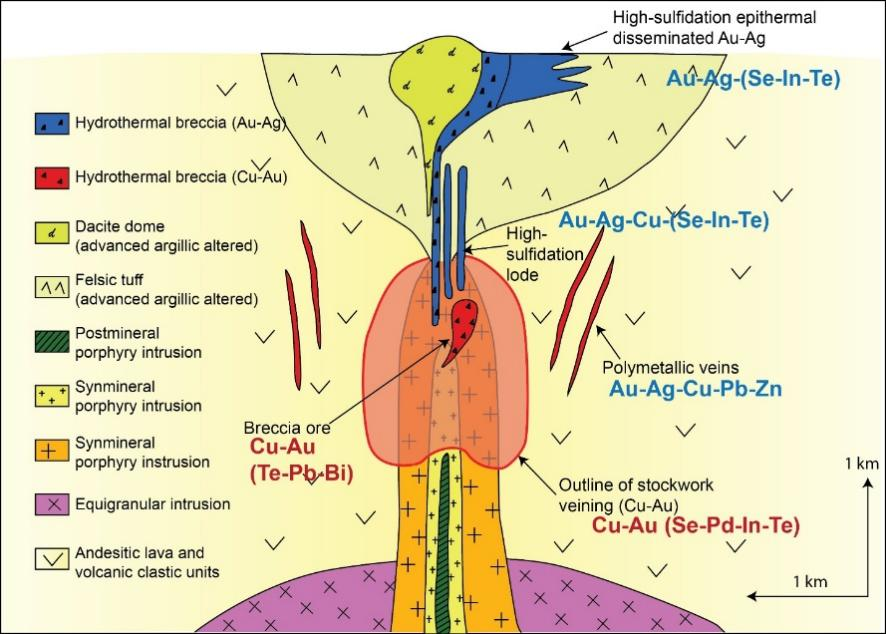
Porphyry systems are considered as low-grade, but high-tonnage, sources of scarce critical metals such as Cu and Mo, but they also host economic by-products of precious metals such as Au and Ag as well as rare trace critical metals such as Se, In, Te, and Re. The latter are of increasing importance as they represent essential components in the manufacture of green energy devices such as solar panels and modern high-tech gadgets. Until recently, the majority of critical trace metals remained in the metallurgical waste streams in most of the large porphyry mines, but several operators in Brazil, China and Japan have already begun to recover them from their mine tailings at an industrial scale. There are two sub-types of porphyry-type deposits: (1) porphyry Cu±Au, and (2) porphyry Mo±Re systems, the former associated with calc-alkaline or alkaline intrusions in continental- or island-arc settings, whereas the latter are normally hosted by more evolved high-K calc-alkaline intrusions derived in post-collisional arc settings. Both sub-types form large S and Fe, rather than Cu and Mo, anomalies in the Earth’s upper crust and are defined by high total sulfide contents with pyrite representing the largest sulfide proportion when compared to the much less abundant directly economic chalcopyrite, bornite, and molybdenite phases. Importantly, pyrite hosts the majority of critical trace metals (Se, In, Te) in porphyry systems and therefore represents a vast untapped resource of these rare critical metals. Understanding the complex deportment of these rare critical elements can facilitate their extraction from pyrite concentrates in the metallurgical processing plants of current and future porphyry mining operations. This can boost their supply at a time when exploration discovery and mining of new porphyry systems have slowed due to a range of geological, governmental, environmental, and social issues and is unlikely to meet demand in the short term.
Graphical Abstract
Keywords
porphyry Cu–Au–Mo mineral systems | critical metals | trace metal deportment | mineral exploration
References
- 1.
Kelley, K.D.; Huston, D.L.; Peter, J.M. Toward an effective global green economy: The critical minerals mapping initiative (CMMI). SGA Newslett. 2021, 48, 1–5.
- 2.
European Commission. Study on the Critical Raw Materials for the EU 2023: Final Report; Publications Office of the European Union: Luxembourg, 2023.
- 3.
Liu, Z.; Wang, S.; Liu, B.; et al. Advanced oxidation processes for sustainable critical metals extraction and recovery: Mechanisms, applications, and future perspectives. J. Environ. Chem. Eng. 2025, 13, 120193.
- 4.
Pandey, R.; Krmíček, L.; Müller D.; et al. Alkaline rocks and their economic and geodynamic significance through geological time. In Alkaline Rocks: Economic and Geodynamic Significance through Geological Time; Geological Society of London: London, UK, 2025; Volume 551.
- 5.
Groves, D.I.; Santosh, M.; Zhang, L. Net zero climate remediations and potential terminal depletion of global critical metal resources: A synoptic geological perspective. Geosyst. Geoenviron. 2023, 2, 100136.
- 6.
Funari, V.; Gomes, H.I.; Coppola, D.; et al. Opportunities and threats of selenium supply from unconventional and low-grade ores: A critical review. Resour. Conserv. Recycl. 2021, 170, 105593.
- 7.
Nassar, N.T.; Kim, H.; Frenzel, M.; et al. Global tellurium supply potential from electrolytic copper refining. Resour. Conserv. Recycl. 2022, 184, 106434.
- 8.
Ahmad, N.I.; Kar, Y.B.; Doroody, C.; et al. A comprehensive review of flexible cadmium telluride solar cells with back surface field layer. Heliyon 2023, 9, e21622.
- 9.
He, X.; You, Y.; Li, W.; et al. The enrichment mechanism of indium in Fe-enriched sphalerite from the Bainiuchang Zn-Sn polymetallic deposit, SW China. Ore Geol. Rev. 2024, 167, 105981.
- 10.
Ivanov, V.V.; Yushko-Zakharova, O.E. Rhenium. In Siderophile and Chalcophile Rare Metals Geological Directory; Nedra: Moscow, Russia, 1989; pp. 425–459.
- 11.
Müller, D.; Groves, D.I.; Santosh, M. Metallic Mineral Resources: The Critical Components for a Sustainable Earth; Elsevier: Amsterdam, The Netherlands, 2024; 474 p.
- 12.
Sinclair, W.D. Porphyry deposits. In Mineral Deposits of Canada: A Synthesis of Major Deposit Types, District Metallogeny, the Evolution of Geological Provinces, and Exploration Methods; Goodfellow, W. D., Ed.; Special Publication No. 5; Geological Association of Canada, Mineral Deposits Division: St. John’s, NL, Canada, 2007; pp. 223–243.
- 13.
Sillitoe, R.H. Porphyry copper systems. Econ. Geol. 2010, 105, 3–41.
- 14.
Sun, W.; Huang, R.; Li, H.; et al. Porphyry deposits and oxidized magmas. Ore Geol. Rev. 2015, 65, 97–131.
- 15.
Zhang, Q.; Tang, J.; Li, F.; et al. Petrogenesis of the Tiegeshan diorite porphyry in the Duolong ore district, Tibet: Implications for porphyry mineralization. Ore Geol. Rev. 2026, 191, 107207.
- 16.
Simon, A.C.; Ripley, E.M. The role of magmatic sulfur in the formation of ore deposits. Rev. Mineral. Geochem. 2011, 73, 513–578.
- 17.
Richards, J.P.; Mumin, A.H. Magmatic-hydrothermal processes within an evolving Earth: Iron oxide-copper-gold and porphyry Cu±Mo±Au deposits. Geology 2013, 41, 767–770.
- 18.
Blundy, J.; Mavrogenes, J.; Tattitch, B.; et al. Generation of porphyry copper deposits by gas–brine reaction in volcanic arcs. Nat. Geosci. 2015, 8, 235–240.
- 19.
Rezeau, H.; Jagoutz, O. The importance of H2O in arc magmas for the formation of porphyry Cu deposits. Ore Geol. Rev. 2020, 126, 103744.
- 20.
Audetat, A.; Li, W. The genesis of Climax-type porphyry Mo deposits: Insights from fluid inclusions and melt inclusions. Ore Geol. Rev. 2017, 88, 436–460.
- 21.
Heinrich, C.A. The chain of processes forming porphyry copper deposits. Econ. Geol. 2024, 119, 741–769.
- 22.
Cioacă, M.E.; Munteanu, M.; Qi, L.; et al. Trace element concentrations in porphyry copper deposits from Metaliferi Mountains, Romania: A reconnaissance study. Ore Geol. Rev. 2014, 63, 22–39.
- 23.
McFall, K.; Roberts, S.; Teagle, D.; et al. The origin and distribution of critical metals (Pd, Pt, Te and Se) within the Skouries Cu–Au porphyry deposit, Greece. Trans. Inst. Min. Metall. Sect. B 2016, 125, 100–101.
- 24.
Rivas-Romero, C.; Reich, M.; Barra, F.; et al. The relation between trace element composition of Cu-(Fe) sulfides and hydrothermal alteration in a porphyry copper deposit: Insights from the Chuquicamata underground mine, Chile. Minerals 2021, 11, 671.
- 25.
Steadman, J.; Large, R.; Olin, P.; et al. Pyrite trace element behavior in magmatic-hydrothermal environments: An LA-ICPMS imaging study. Ore Geol. Rev. 2021, 128, 103878.
- 26.
Brodbeck, H.; McClenaghan, S.H.; Kamber, B.S.; et al. Metal(loid) deportment in sulfides from the high-grade core of the Bingham Canyon porphyry Cu-Mo-Au deposit, Utah. Econ. Geol. 2022, 117, 1521–1524.
- 27.
Plotinskaya, O.Y.; Azovskova, O.B.; Belogub, E.V. Telluride mineralogy in ores of the Birgilda porphyry copper deposit (South Urals, Russia). Geol. Ore Depos. 2025, 67, 799–811.
- 28.
Fathollahzadeh, H.; Mena, J.C.; Jowitt, S.M. Assessing the geochemical anomalies of bismuth, gallium, indium, and tellurium in the Río Blanco porphyry Cu-Mo deposit, central Chile; implications for the critical mineral and metal potential of porphyry copper systems. Miner. Depos. 2026, 61, 775–782.
- 29.
Jin, Y.; Xie, G.; Mao, J.; et al. The behavior of Se and Te during porphyry Cu-associated magmas evolution in the Middle-Lower Yangtze River metallogenic belt. Lithos 2026, 523, 108364.
- 30.
Whitworth, A.J.; Vaughan, J.; Southam, G.; et al. Review on metal extraction technologies suitable for critical metal recovery from mining and processing wastes. Miner. Eng. 2022, 182, 107537.
- 31.
Sun, Z.; Wu, J.; Cheng, H.; et al. Research progress on the extraction of strategic critical metals and the high value utilization of major element silicon from bulk mineral-metallurgical solid waste. J. Environ. Chem. Eng. 2025, 13, 118119.
- 32.
Restivo, J.; Souza, J.P.S. Closed-loop mining waste management: Modification of clay byproducts for recovery of heavy metals from acid mine drainage. Colloids Surf. A: Physicochem. Eng. Asp. 2026, 737, 139736.
- 33.
Viola, V.O.; Fernandes de Aquino, T.; Bonetti, B.; et al. Treatment of acid mine drainage (AMD) from the Santa Catarina Basin (Brazil) to retrieve rare earth. J. Water Process Eng. 2026, 82, 109549.
- 34.
Zeng, L.; Deng, S.; Pan, Y.; et al. Sustainable preparation of battery-grade FePO4·H2O from acid mine drainage through a precipitation-purification pathway. Resour. Conserv. Recycl. 2026, 225, 108643.
- 35.
Berzina, A.N.; Sotnikov, V.I.; Economou-Eliopoulos, M.; et al. Distribution of rhenium in molybdenite from porphyry Cu–Mo and Mo–Cu deposits of Russia (Siberia) and Mongolia. Ore Geol. Rev. 2005, 26, 91–113.
- 36.
Lausberg, E.; Brugger, J.; Ram, R.; et al. Wasting the risk, or risking the waste? Understanding the trends of critical raw material loss into waste streams during copper and aluminium processing. Resour. Conserv. Recycl. 2026, 228, 108803.
- 37.
Groves, D.I.; Santosh, M.; Müller, D.; et al. Mineral systems: Their advantages in terms of developing holistic genetic models and for target generation in global mineral exploration. Geosyst. Geoenviron. 2022, 1, 100001.
- 38.
Zhang, L.; Groves, D.I.; Deng, J.; et al. Gold: From birth in neutron star collisions to human exploitation on Earth’s crust. Ore Geol. Rev. 2025, 187, 106966.
- 39.
Garwin, S.; Hall, R.; Watanabe, Y. Tectonic setting, geology, and gold and copper mineralization in Cenozoic magmatic arcs of southeast Asia and the west Pacific. Econ. Geol. 2005, 100, 891–930.
- 40.
Diaz-Rodriguez, J.; Müller, R.D.; Chandra, R. Predicting the emplacement of cordilleran porphyry copper systems using a spatiotemporal machine learning model. Ore Geol. Rev. 2021, 137, 104300.
- 41.
Rabbia, O. Metal endowment and fertility of Andean porphyrycopper belts. Ore Geol. Rev. 2026, 190, 107153.
- 42.
Hedenquist, J.W.; Harris, M.; Camus, F. Geology and genesis of major copper deposits and districts of the world: A tribute to Richard H. Sillitoe. Econ. Geol. Spec. Publ. 2012, 16, 1–618.
- 43.
Groves, D.I.; Santosh, M. Mineral Systems, Earth Evolution, and Global Metallogeny; Elsevier: Amsterdam, The Netherlands, 2023; 251 p.
- 44.
Sillitoe, R.H.; Perello, J. Andean copper province: Tectonomagmatic settings, deposit types, metallogeny, exploration, and discovery. Econ. Geol. 2005, 100, 845–890.
- 45.
Gow, P.A.; Walshe, J.L. The Role of preexisting geologic architecture in the formation of giant porphyry-related Cu±Au deposits: Examples from New Guinea and Chile. Econ. Geol. 2005, 100, 819–833.
- 46.
Salfity, J.A. Lineamentos transversales al rumbo andino en el noroeste argentino. In Actas del IV Congreso Geológico Chileno; Asociación Geológica de Chile: Antofagasta, Chile, 1985; Volume 2, pp. 119–137.
- 47.
Camus, F.; Castelli, J.C. Historia exploracion y geologia de los yacimientos metaliferos de Chile 900–2020; Origo Ediciones: Santiago, Chile, 2021; 1338 p.
- 48.
Pena, M.; Palma, G.; Comte, D.; et al. Upper-crustal architecture and transpressional controls in the formation of the El Abra, Radomiro Tomic, and Chuquicamata porphyry copper systems, northern Chile. Ore Geol. Rev. 2025, 187, 106956.
- 49.
Matteini, M.; Mazzuoli, R.; Omarini, R.; et al. The geochemical variations of the upper Cenozoic volcanism along the Calama–Olacapato–El Toro transversal fault system in the central Andes (24°S). Tectonophysics 2002, 345, 211–227.
- 50.
Urzua, F. Geology, Geochronology and Structural Evolution of La Escondida Copper District, Northern Chile. Ph.D. Thesis, University of Tasmania, Dynnyrne, TAS, Australia, 2009.
- 51.
Pollard, P.J.; Taylor, R.G. Paragenesis of the Grasberg Cu-Au deposit, Irian Jaya, Indonesia: Results from logging Section 13. Miner. Depos. 2002, 37, 117–136.
- 52.
Dwyer, R.; Forster, D.B.; Simpson, B.; et al. Relationships between high-K magmas and Cu–Au porphyry deposits in the Macquarie Arc, Australia. Geol. Soc. Spec. Publ. 2025, 551, 259–300.
- 53.
Crane, D.; Kavalieris, I. Geologic overview of the Oyu Tolgoi porphyry Cu-Au-Mo deposits, Mongolia. Econ. Geol. Spec. Publ. 2012, 16, 187–213.
- 54.
Olson, N.H.; Dilles, J.H.; Kent, A.J.; et al. Geochemistry of the Cretaceous Kaskanak batholith and genesis of the Pebble porphyry Cu-Au-Mo deposit, SW Alaska. Am. Mineral. 2017, 102, 1597–1621.
- 55.
Deng, J.; Wang, Q.F., Gao, L.; et al. Differential crustal rotation and its control on giant ore clusters along the eastern margin of Tibet. Geology 2021, 49, 428–432.
- 56.
Wang, R.; Zhu, D.C.; Wang, Q.; et al. Porphyry mineralization in the Tethyan orogen. Sci. China Earth Sci. 2020, 62, 2042–2067.
- 57.
Hao, H.; Park, J.W.; Zheng, Y.C.; et al. Role of chalcophile element fertility in the formation of the eastern Tethyan post-collisional porphyry Cu deposits. Miner. Depos. 2024, 59, 1579–1594.
- 58.
Müller, D.; Groves, D.I. Potassic Igneous Rocks and Gold-Copper Mineralization, 5th ed.; Springer: Cham, Switzerland, 2019; 398 p.
- 59.
Chang, J.; Audetat, A.; Pettke, T. The gold content of felsic to mafic potassic magmas. Nat. Commun. 2024, 15, 6988.
- 60.
Corbett, G.J.; Leach, T.M. Southwest Pacific Rim Gold-Copper Systems: Structure, Alteration, and Mineralization; Society of Economic Geologists: Littleton, CO, USA, 1998; Volume 6, 240 p.
- 61.
Yang, Z.; Cao, K. Post-collisional porphyry Cu deposits in Tibet: An overview. Earth Sci. Rev. 2024, 258, 104954.
- 62.
Chen, Y.J.; Zhang, C.; Wang, P.; et al. The Mo deposits of Northeast China: A powerful indicator of tectonic settings and associated evolutionary trends. Ore Geol. Rev. 2017, 81, 602–640.
- 63.
Li, Z.Z.; Qin, K.Z.; Li, G.M.; et al. Formation of the giant Chalukou porphyry Mo deposit in northern great Xing’an range, NE China. Lithos 2014, 203, 138–156.
- 64.
Ludington, S.; Plumlee, G.S. Climax-Type Porphyry Molybdenum Deposits; U.S. Geological Survey Open-File Report 2009–1215; U.S. Geological Survey: Reston, VA, USA, 2009; pp. 1–16.
- 65.
Zhong, J.; Chen, Y.J.; Pirajno, F. Geology, geochemistry and tectonic settings of the molybdenum deposits in South China: A review. Ore Geol. Rev. 2017, 81, 829–855.
- 66.
Zeng, Q.; Liu, J.; Qin, K.; et al. Types, characteristics, and time–space distribution of molybdenum deposits in China. Int. Geol. Rev. 2013, 55, 1311–1358.
- 67.
Carten, R.B.; White, W.H.; Stein, H.J. High-grade granite-related molybdenum systems: Classification and origin. Geol. Assoc. Canada, Spec. Pap. 1993, 40, 521–554.
- 68.
Klemm, L.M.; Pettke, T.; Heinrich, C.A. Fluid and source magma evolution of the Questa porphyry Mo deposit, New Mexico, USA. Miner. Depos. 2008, 43, 533–552.
- 69.
Yang, Y.F.; Chen, Y.J.; Piranjo, F.; et al. Evolution of ore fluids in the Donggou giant porphyry Mo system, East Qinling, China. Ore Geol. Rev. 2015, 65, 148–164.
- 70.
Soloviev, S.G. Late Paleozoic high-K magmatism and related metallogeny of the Tien Shan orogenic belt, Central Asia. Geol. Soc. Spec. Publ. 2025, 551, 231–258.
- 71.
Loucks, R.R. Distinctive composition of copper-ore-forming magmas. Aust. J. Earth Sci. 2014, 61, 5–16.
- 72.
Bekaert, D.V.; Turner, S.J.; Broadley, M.W.; et al. Subduction-driven volatile recycling: A global mass balance. Ann. Rev. Earth Planet. Sci. 2021, 49, 37–70.
- 73.
Waters, L.E.; Cottrell, E.; Coombs, M.L.; et al. Generation of calcalkaline magmas during crystallization at high oxygen fugacity. J. Petrol. 2021, 62, egaa104.
- 74.
Mafra, C.; Loucks, R.; Fiorentini, M. Distinctive source and hydration state of gold-ore-forming arc magmas. Geology 2024, 53, 195–200.
- 75.
Bao, X.S.; Yang, L.Q., He, W.Y.; et al. Importance of magmatic water content and oxidation state for porphyry-style Au mineralization: An example from the giant Beiya Au deposit, SW China. Minerals 2018, 8, 441.
- 76.
Richards, J.P. Porphyry copper deposit formation in arcs: What are the odds? Geosphere 2022, 18, 130–155.
- 77.
Lamont, T.N.; Loader, M.A.; Roberts, N.M.; et al. Porphyry copper formation driven by water-fluxed crustal melting during flat-slab subduction. Nat. Geosci. 2024, 17, 1306–1315.
- 78.
Lee, C.T.; Leeman, W.P.; Canil, D.; et al. Similar V/Sc systematic in MORB and arc basalts: Implications for the oxygen fugacities of their mantle source regions. J. Petrol. 2005, 46, 2313–2336.
- 79.
Halter, W.E.; Pettke, T.; Heinrich, C.A. The origin of Cu/Au ratios in porphyry type ore deposits. Science 2002, 296, 1844–1846.
- 80.
Audetat, A.; Chang, J.; Gaynor, S.P. Depth of magma crystallization and fluid exsolution beneath the porphyry-skarn Cu deposits at Santa Rita and Hanover-Fierro, New Mexico, USA. Econ. Geol. 2025, 120, 1679–1699.
- 81.
Murakami, H.; Seo, J.K.; Heinrich, C.A. The relation between Cu/Au ratio and formation depth of porphyry-style Cu-Au±Mo deposits. Miner. Depos. 2009, 45, 11–21.
- 82.
Weis, P.; Driesner, T.; Heinrich, C.A. Porphyry-copper ore shells form at stable pressure-temperature fronts within dynamic fluid plumes. Science 2012, 338, 1613–1616.
- 83.
Cao, M.J.; Qin, K.Z.; Li, G.M.; et al. Oxidation state inherited from the magma source and implications for mineralization: LateJurassic to Early-Cretaceous granitoids, central Lhasa subterrane, Tibet. Miner. Depos. 2018, 53, 299–309.
- 84.
Lee, R.G.; Dilles, J.H.; Tosdal, R.M.; et al. Magmatic evolution of granodiorite intrusions at the El Salvador porphyry copper deposit, Chile. Econ. Geol. 2017, 112, 245–273.
- 85.
Richards, J.P. Post-subduction porphyry Cu-Au and epithermal Au deposits: Products of remelting of subduction-modified lithosphere. Geology 2009, 37, 247–250.
- 86.
Zhong, S.; Feng, C., Seltmann, R.; et al. Geochemical contrasts between late Triassic ore-bearing and barren intrusions in the Weibao Cu-Pb-Zn deposit, east Kunlun Mountains, NW China. Miner. Depos. 2018, 53, 855–870.
- 87.
Richards, J.P. Alkalic-type epithermal gold deposits: A review. In Magmas, Fluids, and Ore Deposits; Thompson, J.F.H., Ed.; Mineralogical Association of Canada Short Course Series; Mineralogical Association of Canada: Toronto, ON, Canada, 1995; Volume 23, pp. 367–400.
- 88.
Williams, H.M.; Prytulak, J.; Woodhead, J.D.; et al. Interplay of crystal fractionation, sulfide saturation and oxygen fugacity on the iron isotope composition of arc lavas: An example from the Marianas. Geochim. Cosmochim. Acta 2018, 226, 224–243.
- 89.
Halley, S. Mapping magmatic and hydrothermal processes from routine exploration geochemical analyses. Econ. Geol. 2020, 115, 489–503.
- 90.
Voudoulis, P.; Mavroganatos, C.; Spry, P.; et al. Porphyry and epithermal deposits in Greece: An overview, new discoveries, and mineralogical constraints on their genesis. Ore Geol. Rev. 2019, 107, 654-691.
- 91.
Portela, B.; Sepp, M.D.; van Ruitenbeek, F.J.A.; et al. Using hyperspectral imagery for identification of sillitoeboucherpyrophyllitemuscovite intergrowths and alunite in the shallow epithermal environment of the Yerington porphyry copper district. Ore Geol. Rev. 2021, 131, 104012.
- 92.
Heinrich, C.A. The physical and chemical evolution of low-salinity magmatic fluids at the porphyry to epithermal transition: A thermodynamic study. Miner. Depos. 2005, 39, 864–889.
- 93.
Saber, E.S.; El-Wahed, M.A.; El-Sheikh, A.; et al. Fertile high-K magmatism and hydrothermal alteration zone associated with porphyry copper mineralization in the Samra area, SE Sinai, Egypt. Sci. Rep. 2025, 15, 44223.
- 94.
Mpodozis, C.; Cornejo, P. Cenozoic tectonics and porphyry copper systems of the Chilean Andes. Econ. Geol. Spec. Publ. 2012, 16, 329–360.
- 95.
McInnes, B.I.; Evans, N.J.; Fu, F.Q.; et al. Application of thermochronology to hydrothermal ore deposits. Rev. Mineral. Geochem. 2005, 58, 467–498.
- 96.
Barley, M.E. Porphyry-style mineralization associated with early Archean calc-alkaline igneous activity, eastern Pilbara, Western Australia. Econ. Geol. 1982, 77, 1230–1236.
- 97.
Turner, S.J.; Reynolds, J.; Hagemann, S.G. Boddington: An enigmatic giant Archean gold-copper (molybdenum-silver) deposit in the southwest Yilgarn Craton, Western Australia. Econ. Geol. Spec. Publ. 2020, 23, 275–288.
- 98.
Outteridge, T.; Kinsman, N.; Ronchi, G. Industrial relevance of molybdenum in China. Adv. Manuf. 2020, 8, 35–39.
- 99.
Liu, L.; Zhang, L.; Jiang, S.; et al. Global copper cycles in the anthroposphere since the 1960s. Resour. Conserv. Recycl. 2023, 199, 107294.
- 100.
Youngman, T.H.; Nielsen, R.; Crovetto, A.; et al. Semitransparent selenium solar cells as a top cell for tandem photovoltaics. Sol. RRL 2021, 5, 2100111.
- 101.
Liu, F.W.; Cheng, T.M.; Chen, Y.J.; et al. High-yield recycling and recovery of copper, indium, and gallium from waste copper indium gallium selenide thin-film solar panels. Sol. Energy Mater. Sol. Cells 2022, 241, 111691.
- 102.
Cerchiaro Sanchez, I. Critical Minerals in Copper and Molybdenum-Tungsten Deposits Associated with Laramide-age Intrusions of the Hillsboro and Eureka Districts, and Paleogene-age Victorio and Tres Hermanas Districts, New Mexico. Master’s Thesis, New Mexico Institute of Mining and Technology, Socorro, NM, USA, 2025.
- 103.
Chivers, T.; Laitinen, R.S. Tellurium: A maverick among the chalcogens. Chem. Soc. Rev. 2015, 44, 1725–1739.
- 104.
Albarede, F. Geochemistry; Cambridge University Press: Cambridge, UK, 2013; 342 p.
- 105.
Rumble, J. R., Ed. CRC Handbook of Chemistry and Physics, 102nd ed.; CRC Press: Boca Raton, FL, USA, 2021; 1550 p.
- 106.
Wu, X.; Xie, G.; Xu, J.; et al. Distribution of Co, Te, Se in porphyry copper systems: A case study of the Tonglvshan deposit, Eastern China. Ore Geol. Rev. 2024, 174, 106304.
- 107.
Graham, A.C.; Orovan, E.A.; Wall, C.; et al. Data Release from Critical Mineral Studies of the Kitsault, Huckleberry, and Berg Porphyry Deposits; British Columbia Geological Survey GeoFile, GeoFile 2025–23; British Columbia Ministry of Mining and Critical Minerals, British Columbia Geological Survey: Victoria, BC, Canada, 2025; pp. 1–11.
- 108.
Singer, D.A.; Berger, V.I.; Moring, B.C. Porphyry Copper Deposits of the World: Database and Grade and Tonnage Models; U.S. Geological Survey Open-File Report 2008-1155; U.S. Geological Survey (USGS): Reston, VA, USA, 2008.
- 109.
Rubin, J.N.; Kyle, J.R. Precious metal mineralogy in porphyry-, skarn-, and replacement-type ore deposits of the Ertsberg (Gunung Bijih) District, Irian Jaya, Indonesia. Econ. Geol. 1997, 92, 535–550.
- 110.
George, L.L.; Cook, N.J.; Crowe, B.B.; et al. Trace elements in hydrothermal chalcopyrite. Mineral. Mag. 2018, 82, 59–88.
- 111.
Seedorff, E.; Dilles, J.H.; Profett, J.M.; et al. Porphyry deposits: Characteristics and origin of hypogene features. Econ. Geol. 2005, 100, 251–298.
- 112.
Vigneresse, J.L.; Poddar, A.; Chattaraj, P.K. Felsic trans-porphyry deposits and associated ore (Sn, Ta, Nb, pegmatites) viewed from physics, chemistry (cDFT) and geologic contexts. Lithos 2025, 515, 108200.
- 113.
Landtwing, M., Pettke, T., Halter, W.E.; et al. Copper deposition during quartz dissolution by cooling magmatic–hydrothermal fluids: The Bingham porphyry. Earth Planet. Sci. Lett. 2005, 235, 229–243.
- 114.
Sinclair, W.D.; Jonasson, I.R.; Kirkham, R.V.; et al. Rhenium in Canadian mineral deposits. In Proceedings of the 24th International Applied Geochemistry Symposium; International Association of Applied Geochemistry: Fredericton, NB, Canada, 2009; pp. 225–228.
- 115.
Dai, J.Z.; Mao, J.W.; Yang, F.Q.; et al. Geological characteristics and geodynamic background of the molybdenum (copper) deposits along Yanshan–Liaoning metallogenic belt at the northern margin of North China block. Miner. Depos. 2006, 25, 598–615.
- 116.
Voudouris, P.; Melfos, V.; Spry, P.G.; et al. Extremely Re rich molybdenite from porphyry Cu-Mo-Au prospects in northeastern Greece: Mode of occurrence, causes of enrichment, and implications for gold exploration. Minerals 2013, 3, 165–191.
- 117.
Ma, W.; Wen, H.; Zhou, Z.; et al. Vapor phase facilitated rhenium enrichment in porphyry Mo deposit: Insights from thermodynamic simulations and molybdenum isotopes at Jinduicheng deposit, central China. J. Geochem. Explor. 2026, 286, 108057.
- 118.
Xiong, X.; Zhu, L., Yang, P.; et al. Texture, geochemistry and U–Pb geochronology of monazite of different origins: Implications for the magmatic–hydrothermal evolution of the Guilingou porphyry Mo-W deposit, South Qinling Orogen, central China. Ore Geol. Rev. 2025, 182, 106648.
- 119.
Nie, X.T.; Sun, J.G., Sun, F.Y.; et al. Zircon U–Pb and molybdenite Re–Os dating and geological implications of the Shimadong porphyry molybdenum deposit in eastern Yanbian, northeastern China. Can. J. Earth Sci. 2020, 57, 630–646.
- 120.
Liu, H.; Wang, J.; Chen, Q.; et al. Magmatic evolution and Nb-Ta enrichment of Early Jurassic granitic porphyry from the Shangxiahu Nb-Ta deposit of the Nanling Range, China. Minerals 2024, 14, 1005.
- 121.
Qi, J.; Chi, G.; Tang, J.; et al. In-situ trace element and sulfur isotope analyses of sulfides as indicators of ore-forming fluid evolution in the Lakang’e porphyry Mo-Cu deposit, Tibet, China. Ore Geol. Rev. 2025, 183, 106690.
- 122.
Berger, B.R.; Ayuso, R.A.; Wynn, J.C.; et al. Preliminary Model of Porphyry Copper Deposits; U.S. Geological Survey Open-File Report 2008-1321; U.S. Geological Survey: Reston, VA, USA, 2008; pp. 1–62.
- 123.
Nielsen, R.L. Hypogene texture and mineral zoning in a copperbearing granodiorite stock, Santa Rita, New Mexico. Econ. Geol. 1968, 63, 37–50.
- 124.
Gustafson, L.B.; Hunt, J.P. The porphyry Cu deposit at El Salvador, Chile. Econ. Geol. 1976, 70, 857–912.
- 125.
John, E.C. Mineral zones in the Utah Copper orebody. Econ. Geol. 1978, 73, 1250–1259.
- 126.
Bogdanov, K. Pyrite and chalcopyrite as minerals-vectors toward porphyry-epithermal systems. In Abstracts of the National Conference “GEOSCIENCES 2015”; Bulgarian Geological Society: Sofia, Bulgaria, 2015; pp. 13–14.
- 127.
Boucher, B.M.; Robb, S.J.; Hanley, J.J.; et al. Platinum-group elements (PGE) in the New Afton alkalic Cu-Au porphyry deposit, Canadian Cordillera, I: Relationships between PGE, accessory metals and sulfur isotopes in pyrite. Front. Earth Sci. 2023, 11, 819129.
- 128.
Keith, M.; Smith, D.J.; Jenkin, G.R.; et al. A review of Te and Se systematics in hydrothermal pyrite from precious metal deposits: Insights into ore-forming processes. Ore Geol. Rev. 2018, 96, 269–282.
- 129.
Xiao, X.; Zhou, T.; Hollings, P.; et al. Pyrite geochemistry in a porphyry-skarn Cu (Au) system and implications for ore formation and prospecting: Perspective from the Xinqiao deposit, Eastern China. Am. Mineral. 2023, 108, 1132–1148.
- 130.
Wang, C.; Li, S.; Wang, H.; et al. Selenium minerals and the recovery of selenium from copper refinery anode slimes. J. South. Afr. Inst. Min. Metall. 2016, 116, 593–600.
- 131.
Martin, A.J.; McDonald, I.; MacLeod, C.J.; et al. Extreme enrichment of selenium in the Apliki Cyprus-type VMS deposit, Troodos, Cyprus. Mineral. Mag. 2018, 82, 697–724.
- 132.
Chen, J.; Huang, Z.L., Yang, R.D.; et al. Gold and antimony metallogenic relations and ore-forming process of Qinglong Sb-(Au) deposit in Youjiang basin, SW China: Sulfide trace elements and sulfur isotopes. Geosci. Front. 2021, 12, 605–623.
- 133.
Chouinard, A.; Paquette, J.; William-Jones, A.E. Crystallographic controls on trace-element incorporation in auriferous pyrite from the Pascua epithermal high-sulfidation deposit: Chile-Argentina. Can. Mineral. 2005, 43, 951–963.
- 134.
Müller, D.; Groves, D.I.; Zhang, L. Towards a circular economy: Modern recycling technologies for critical metals. Gondwana Res. 2026, 152, 80–91.
- 135.
Schodde, R. Time delay between discovery and development— Is it becoming more difficult? Presented at the China Mining 2017 Conference, Tianjin, China, 23 September 2017.
- 136.
Guj, P.; Schodde, R. Will future copper resources and supply be adequate to meet the net zero emission goal? Geosyst. Geoenviron. 2025, 4, 100320.
- 137.
Wu, C.; Chen, H.; Chiaradia, M.; et al. Linking Pacific Plate formation and Early Cretaceous metallogenic response on the circumPacific continental margins. GSA Bull. 2023, 136, 171–183.
- 138.
Cocker, H.A.; Valente, D.L.; Park, J.W.; et al. Using platinum group elements to identify sulfide saturation in a porphyry Cu system: The El Abra porphyry Cu deposit, northern Chile. J. Petrol. 2016, 56, 2491–2514.
- 139.
Chitalin, A.F.; Baksheev, I.A.; Nikolaev, Y.N.; et al. Porphyry Cu– Au±Mo Mineralization Hosted by Potassic Igneous Rocks: Implications from the Giant Peschanka Porphyry Deposit, Baimka Trend (North East Siberia, Russia); Geological Society of London: London, UK, 2022; Volume 513, pp. 323–349.
- 140.
Clark, D.A. Magnetic effects of hydrothermal alteration in porphyry copper and iron-oxide copper–gold systems: A review. Tectonophysics 2014, 625, 46–65.
- 141.
Kwan, K.; Müller, D. Mount Milligan alkalic porphyry Au-Cu deposit, British Columbia, Canada, and its AEM and AIP signatures: Implications for mineral exploration in covered terrains. J. Appl. Geophys. 2020, 180, 104131.
- 142.
Yang, F.; Zuo, R.; Kreuzer, O. Artificial intelligence for mineral exploration: A review and perspectives on future directions from data science. Earth-Sci. Rev. 2024, 258, 104941.
- 143.
Davies, R.S.; Trott, M.; Georgi, J.; et al. Artificial intelligence and machine learning to enhance critical mineral deposit discovery. Geosyst. Geoenviron. 2025, 4, 100361.
- 144.
Ning, Y.; Wang, Y., Lu, J.; et al. Mineral prospectivity mapping for multi-source geoscience data: A novel unsupervised deep learning method. Ore Geol. Rev. 2025, 186, 106866.
- 145.
Mitra, S.; Mallick, S.; Biswas, S.; et al. Advanced machine learning based gold prospectivity mapping in the Dharwar Craton, India: A hybrid knowledge-data driven paradigm integrating ensemble and deep learning. Geosyst. Geoenviron. 2026, 5, 100473.



Yorumlar
Yorum Gönder